Home / News /
UW IHDD Program Expands CCTV Lending for Adults
For many Washington residents living with vision loss, a desktop video magnifier makes it possible to read mail, manage medications, write notes to loved ones, and continue enjoying favorite hobbies. Through the Independent Living (IL) Program, access is becoming possible for more adults across the state.
The Independent Living (IL) Program is part of the Washington State Department of Services for the Blind (DSB) and is managed by the UW Center for Technology and Disability at the UW Institute on Human Development and Disability (IHDD). While IHDD is widely known for its work with children and families, it is a lifespan institute that also supports adults with disabilities. The IL Program specifically serves adults who are blind or have low vision and who want to live independently.
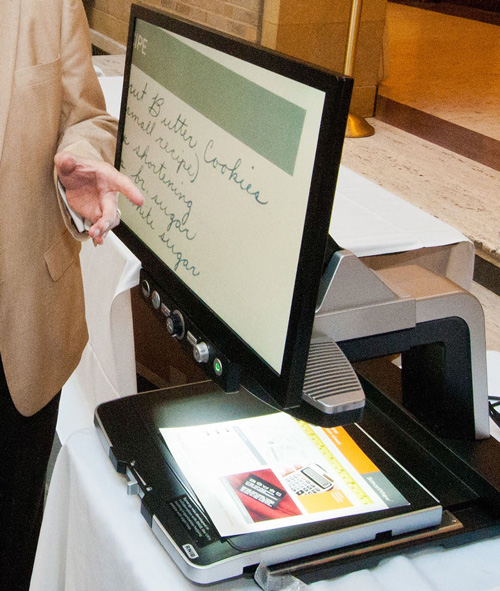
“Large CCTV reader for low vision users”, via Wikimedia Commons, licensed under CC BY 2.0
Each year, the IL Program provides services to more than 1,000 Washington residents. The program teaches new ways to complete daily tasks safely, offers brief counseling to support adjustment to vision loss and to build self-confidence, and relies on a statewide network of providers who deliver services within their local communities.
An essential part of this work is providing participants with assistive technology (AT). AT includes any item, piece of equipment, or software that makes tasks easier or possible for people with disabilities. However, low vision and blindness technology can be cost prohibitive for IL Program participants, whose average income ranges from $15,000 to $30,000 per year.
To address this barrier, the IL Program launched the Desktop Video Magnifier (CCTV) Lending Program in 2021 in partnership with the Washington Talking Book and Braille Library (WTBBL). A CCTV is a powerful camera paired with a large monitor that magnifies printed materials far beyond traditional handheld magnifiers.
CCTVs enable participants to read mail and prescription bottles, write letters and cards, view photos of loved ones, check blood sugar levels on glucose monitors, and enjoy hobbies such as knitting and birdwatching.
Through the partnership, more than 100 CCTVs have been loaned at no cost to program participants. Because the devices are durable, ten units have already been returned and redistributed to new participants, with additional returns expected over time.
In 2025, the IL Program surveyed participants who had used their CCTV for at least six months. Among the 69 respondents, nearly 80 percent still use their device. The remaining participants returned theirs for various reasons, most commonly progressive vision loss that made the device no longer useful.
Among participants who continue to use their CCTV, 100 percent reported improved quality of life and 93 percent reported feeling more independent.
Respondents emphasized how essential the device has become in their daily lives:
“I would probably sell a kidney to keep it. It’s my independence. At the time, I didn’t think I was worthy, but this has given me my independence. I don’t know what I’d do without it. I love it.”
“It’s like a miracle for me. It saved my life. I use it all the time.”
“It’s a lifesaver. I don’t know what I would do without it. I don’t know how I would function without it.”
With 62 percent of owners using their device daily and another 33 percent using it weekly, the CCTV Lending Program is helping adults with vision loss maintain independence in their everyday lives.
UW IHDD Program Expands CCTV Lending for Adults
For many Washington residents living with vision loss, a desktop video magnifier makes it possible to read mail, manage medications, write notes to loved ones, and continue enjoying favorite hobbies. Through the Independent Living (IL) Program, access is becoming possible for more adults across the state.
The Independent Living (IL) Program is part of the Washington State Department of Services for the Blind (DSB) and is managed by the UW Center for Technology and Disability at the UW Institute on Human Development and Disability (IHDD). While IHDD is widely known for its work with children and families, it is a lifespan institute that also supports adults with disabilities. The IL Program specifically serves adults who are blind or have low vision and who want to live independently.
“Large CCTV reader for low vision users”, via Wikimedia Commons, licensed under CC BY 2.0
Each year, the IL Program provides services to more than 1,000 Washington residents. The program teaches new ways to complete daily tasks safely, offers brief counseling to support adjustment to vision loss and to build self-confidence, and relies on a statewide network of providers who deliver services within their local communities.
An essential part of this work is providing participants with assistive technology (AT). AT includes any item, piece of equipment, or software that makes tasks easier or possible for people with disabilities. However, low vision and blindness technology can be cost prohibitive for IL Program participants, whose average income ranges from $15,000 to $30,000 per year.
To address this barrier, the IL Program launched the Desktop Video Magnifier (CCTV) Lending Program in 2021 in partnership with the Washington Talking Book and Braille Library (WTBBL). A CCTV is a powerful camera paired with a large monitor that magnifies printed materials far beyond traditional handheld magnifiers.
CCTVs enable participants to read mail and prescription bottles, write letters and cards, view photos of loved ones, check blood sugar levels on glucose monitors, and enjoy hobbies such as knitting and birdwatching.
Through the partnership, more than 100 CCTVs have been loaned at no cost to program participants. Because the devices are durable, ten units have already been returned and redistributed to new participants, with additional returns expected over time.
In 2025, the IL Program surveyed participants who had used their CCTV for at least six months. Among the 69 respondents, nearly 80 percent still use their device. The remaining participants returned theirs for various reasons, most commonly progressive vision loss that made the device no longer useful.
Among participants who continue to use their CCTV, 100 percent reported improved quality of life and 93 percent reported feeling more independent.
Respondents emphasized how essential the device has become in their daily lives:
“I would probably sell a kidney to keep it. It’s my independence. At the time, I didn’t think I was worthy, but this has given me my independence. I don’t know what I’d do without it. I love it.”
“It’s like a miracle for me. It saved my life. I use it all the time.”
“It’s a lifesaver. I don’t know what I would do without it. I don’t know how I would function without it.”
With 62 percent of owners using their device daily and another 33 percent using it weekly, the CCTV Lending Program is helping adults with vision loss maintain independence in their everyday lives.