Home / Services /
Our Developmental Specialty Clinics
 Welcome to the UW IHDD’s Specialty Clinics, where we offer comprehensive interdisciplinary evaluation and support for individuals and families navigating neurodevelopmental disabilities. Our diverse range of specialized clinics include autism, genetics, neurodevelopment, FASD, pediatric audiology, and PKU. Our clinics are dedicated to addressing a wide spectrum of developmental disabilities across the life span and providing tailored care to promote well-being and improve quality of life.
Our Developmental Specialty Clinics
Welcome to the UW IHDD’s Specialty Clinics, where we offer comprehensive interdisciplinary evaluation and support for individuals and families navigating neurodevelopmental disabilities. Our diverse range of specialized clinics include autism, genetics, neurodevelopment, FASD, pediatric audiology, and PKU. Our clinics are dedicated to addressing a wide spectrum of developmental disabilities across the life span and providing tailored care to promote well-being and improve quality of life.
UW Adult Autism Clinic
 The UW Medicine Adult Autism Clinic is designed to meet the complex needs of individuals over 18 years of age with autism spectrum and related disorders. The providers at the Adult Autism Clinic assess the various needs of patients and families and customize care management approaches to assure the best possible patient experience.
Age range: 18+
Email: gastobbe@uw.edu
Phone: 206-598-3100
UW Autism Center
 The UW Autism Center (UWAC) supports autistic individuals, their families, and the community through evidence-based clinical services, innovative research, and professional training.
Part of the Institute on Human Development and Disability (IHDD) at the University of Washington, UWAC unites experts from the School of Medicine, College of Arts & Sciences, and College of Education to advance understanding and support for autism.
Age range: 0-18 years
Email: uwautism@uw.edu
Phone: 877-408-8922
Biochemical Genetics Clinic
 The Biochemical Genetics Clinic provides evaluation, consultation, and management services to clients of all ages with a variety of genetic metabolic disorders (inborn errors of metabolism). These disorders result from an inherited inability to produce a particular enzyme or cofactor necessary for normal metabolism, generally for the production or breakdown of proteins, fats, or carbohydrates.
Age range: 3-6, 14-18
Email: vam@uw.edu
Phone: 206-598-1800
Genetic Medicine Clinic
 The Genetic Medicine Clinic is the only genetics clinic for adults in the Pacific Northwest that offers the full range of evaluation, diagnosis, assessment, genetic testing and interpretation, counseling and care management for all genetic and genomic disorders. We also offer resource referrals to individuals who have genetic disorders in their families or disorders thought to have a genetic component.
Our physicians specializing in medical genetics treat conditions across the spectrum from inherited cancer syndromes to biochemical genetic disorders, neurogenetic disorders, connective tissue disorders, cardiogenetics and inherited skin conditions. Our licensed genetic counselors offer risk assessment and counseling for cancers, along with pre-pregnancy genetic counseling and testing.
Age range: 18+ years
Email: olsondl@uw.edu
Phone: 206-598-4030
Neurogenetics Clinic
The UCEDD’s Neurogenetics Clinic is co-sponsored by the Departments of Neurology and Medicine (Medical Genetics). The clinic’s purpose is to evaluate, diagnose and provide genetic counseling and long-term management for patients and families with a wide variety of genetic diseases of the nervous system. This clinic is also a clinical training site for medical students, residents, and fellows.
The Neurogenetics Clinic is a full-day clinic that meets three times each month. Each year the clinic serves over 300 clients who have an array of neurogenetic disorders including Huntington’s disease, Charcot-Marie-Tooth neuropathy, hereditary neuropathy, hereditary ataxias, muscular dystrophies, familial dementia, familial movement disorders, leukodystrophies, Neimann Pick type C, and others.
Age range: 3-6, 14-18, 22-26
Email: olsondl@uw.edu
Phone: 206-598-4030
Cardiac Neurodevelopment Clinic
 Children who are born with complex congenital heart disease (CHD) are at risk for problems with growth and development. The Cardiac Neurodevelopmental Clinic assesses/evaluates (3 to 4 hours) and treats babies, children and teens with complex congenital heart defects. We provide close follow-up during their first 5 years of life and offer intermittent follow-up and consultation for children age 5-18 years.
Our interdisciplinary team of specialists helps identify developmental concerns early, provides on-going monitoring, and suggests treatment and therapies.
Age range: 6 months -18 years
Email: cncndv@uw.edu
Phone: 206-598-6710
Child Development Clinic

The Child Development Clinic provides developmental assessments and diagnostic services for infants, children, and adolescents up to young adults with developmental concerns. We are a Center for Excellence in diagnosis of Autism Spectrum Disorder as well as many other developmental disabilities. Clinic staff members work in interdisciplinary teams, combining expertise to evaluate each child and make recommendations for care.
Staff members include professionals from audiology, developmental/behavioral pediatrics, nursing, nutrition, occupational therapy, physical therapy, psychology, social work, and speech and language pathology. Clients are diagnosed with an array of developmental disabilities including intellectual disability, autism spectrum disorders, motor disabilities, learning disabilities, behavioral disorders, communication disorders, and attention-deficit hyperactivity disorder.
Age range: 18 mos-18 years
Email: chdevcl@uw.edu
Phone: 206-598-3327
Down Syndrome Specialty Clinic
The Down Syndrome Specialty Clinic was founded in 2016 with the goal to provide long-term developmental and behavioral consults and care for individuals with Down syndrome and their families. The clinic serves children, youth, and young adults. We focus on providing formal developmental assessments, consultation for behavioral concerns, and assessment for common medical problems that can contribute to behavior or development concerns. In addition, we assess for the co-existence of other diagnoses such as ADHD or Autism Spectrum Disorder. Clinic staff members work in interdisciplinary teams, combining expertise to evaluate each child and make recommendations for care.
We strive to help children with Down syndrome reach their greatest potential and have a successful transition to adulthood.
Age range: 6 months-18 years
Email: cncndv@uw.edu
Phone: 206-598-6710
Infant Development Follow-Up Clinic

The Infant Development Follow-Up Clinic (IDFC) provides developmental follow-up of children from 3 months to 5 years of age who have developmental risk factors due to prematurity (born at 32 weeks gestation or earlier), low birth weight (under 1500 grams/ 3 pounds 5 ounces) or prenatal exposure to drugs. The clinic was established in 1977 with the goal of providing early identification and referral for early intervention for developmental and behavioral problems associated with prematurity, drug exposure and other biomedical and environmental risk factors.
Our team of experts works together to assess children’s health and development and connect families with resources as needed.
Age range: 3 months-8 years
Email: idfclamb@uw.edu
Phone: 206-598-9348
Late and Moderate Preterm Babies (LAMBS) Clinic

Our LAMBS Clinic works with children who were born at 32-36 weeks gestation, or 4 to 8 weeks early. We provide developmental assessment and on-going monitoring. We know that these children are at higher risk for developmental differences.
Our goal is to catch any problems early. We want to help your child grow, learn, and thrive to their highest potential.
Age range: 3 months-2 years
Email: idfclamb@uw.edu
Phone: 206-598-9348
Washington State FAS DPN Clinic

The Washington State Fetal Alcohol Syndrome Diagnostic & Prevention Network (FAS DPN) is a network of one Washington State community-based clinic and the core clinical/research/training FAS DPN clinic at IHDD. The FAS DPN clinic at the IHDD was first established in 1993 through support from the Centers for Disease Control. This single clinic was expanded into the statewide FAS DPN clinical network in 1995 through legislation.
The goals of the FAS DPN Clinic are primary and secondary prevention of FASD through screening, diagnosis, research, and training. The FAS DPN Clinic at IHDD provides FASD diagnostic evaluations for individuals under 22 years of age who have a confirmed prenatal alcohol exposure. The team uses a rigorous, validated diagnostic system called the FASD 4-Digit Code to determine a diagnosis.
Age range: Birth-18 years
Email: fasdclin@uw.edu
Phone: 206-598-9666
Pediatric Audiology Clinic
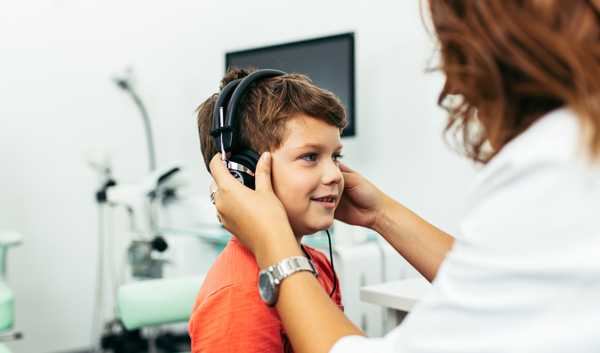
The Pediatric Audiology Clinic at the Institute on Human Development and Disability (IHDD) provides a full range of audiological services for infants and children, including comprehensive hearing evaluations, counseling with families, and fitting and long-term follow-up with hearing technology.
The Pediatric Audiology Clinic has three primary goals:
- To identify hearing loss as early in life as possible
- To provide access to hearing technology for children with permanent hearing loss
- To coordinate follow-up services for intervention, monitoring and ongoing evaluation
Age range: 5-18 years
Email: pedaudio@uw.edu
Phone: 206-598-9347
Phenylketonuria (PKU) Clinic

There are several ways that the Phenylketonuria (PKU) Clinic serves individuals and families.
Individual appointments are conducted with a medical provider (physician assistant or physician) and dietitian/nutritionist. These appointments are generally 45-60 minutes in length and include the following:
- Medical assessment. Individuals meet with a medical provider to discuss PKU management. Children are weighed and measured to ensure that they are growing well.
- Nutrition assessment. The visit also includes meeting with a nutritionist to discuss food and formula intake. Review of a food record helps the nutritionist and the patient/family understand how serum phe levels respond to dietary intake and to make adjustments to keep blood phe levels in a safe range.
Appointments with a genetic counselor can also be scheduled to discuss inheritance, family history, genetic testing, and family planning as it relates to PKU.
Age range: 5-18 years
Email: vam@uw.edu
Phone: 206-598-1800
Preparing for Your Visit
Clinical services at the IHDD serve individuals with or at risk for developmental, learning, and behavioral problems and their families. Clinics also serve adults with a variety of neurodegenerative disorders and related disabilities.
- Map and Directions
- How to Prepare for Your Appointment
- Support Services
- Billing and Insurance